Agencies build the question sets, so it goes wherever the requirements go: the chart, the clinician, the building, the board packet.
What agencies use it for
Accreditation & survey
Prepare for an accreditation survey using the maintained question sets.
Keep monitoring between surveys: ongoing preparedness rather than a scramble in the final weeks.
Moving to a different accrediting body? Rebuild your sets against the new standards and baseline against them.
Work against state Medicaid requirements where that content exists.
Chart & documentation review
Review charts by service type, with a question set per service.
Check documentation quality: place of service, start and stop times, diagnosis, signature and credentials, legibility.
Attach the amount charged to a question set and see what non-compliance is actually worth.
Peer review & supervision
Peer review: clinicians audit one another's services against the same question set, with an optional review step. The audit is submitted, and a manager either approves it or sends it back.
Produce the peer-review documentation you are expected to be able to show.
Onboarding a new clinician: review their early services and give feedback grounded in the same criteria everyone else is held to.
See whether one provider is consistently out of compliance rather than occasionally.
Point training and supervision at what the audits actually found.
Environment & operations
Walk the building with a phone: facility inspections and safety checks recorded where they happen.
Compare programs, locations, and departments against the same requirements.
Governance
Give the board and leadership evidence of a robust compliance process, documented, and running all year.
Show tracking over time: a trend, not a snapshot taken the week before a survey.
Demonstrate a quality-improvement program that is running, not just written down.
Custom questions and question sets
Organizations that already have tracking tools add their own questions to the software and get instant reporting on them, alongside the maintained content.
The content library
You don't have to start from a blank page.
MOST maintains a library of questions, not legal text, written against the standards behavioral health agencies are actually surveyed on, and updated as those standards change.
State Medicaid
Questions covering state Medicaid requirements are maintained for a number of states, and updated on request. Ask whether yours is covered. If it isn't yet, that's a conversation worth having.
Your own questions & question types
Load your own questions and question sets alongside the maintained ones: your policies, your contract requirements, the thing that went wrong last year and must never go wrong again. Questions can also be given custom types, clinical versus non-clinical, or any categorization you use, and reported on by type.
A dollar amount, if you want one
A question set can carry the amount charged for the service being reviewed. That one field is what later turns a compliance rate into a figure your CFO recognizes.
Inside the software
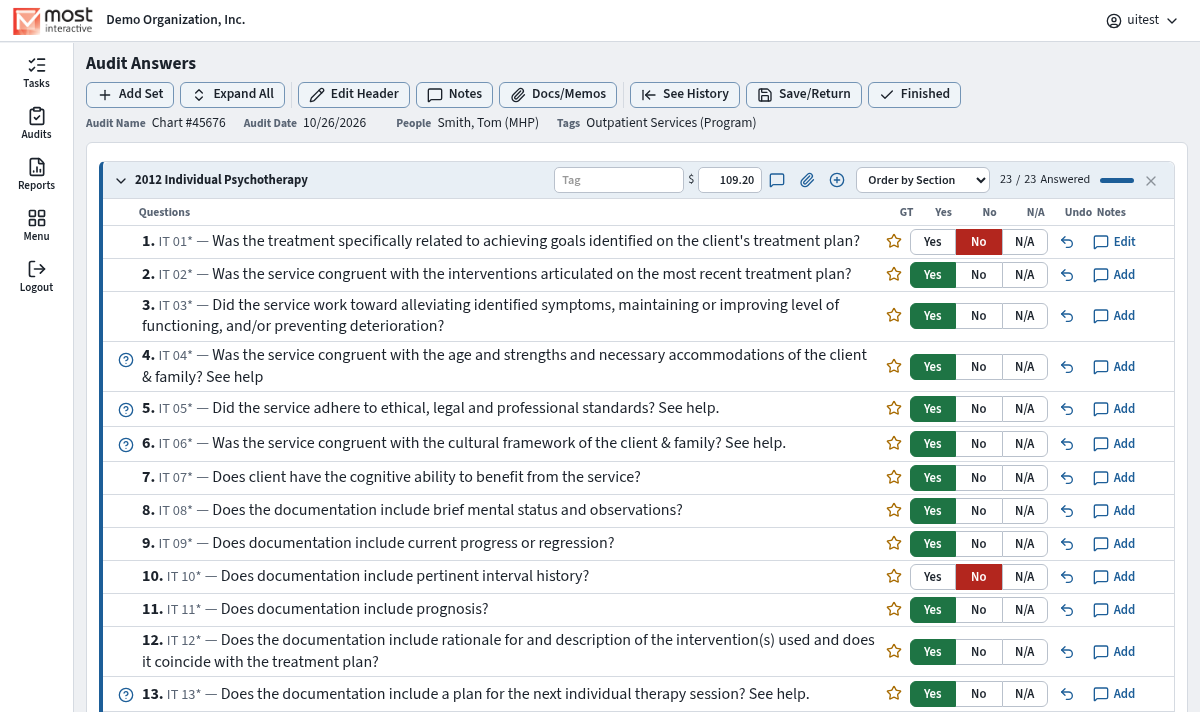
This is what an audit looks like.
No mock-ups. This is the screen an auditor works in.
Actual MOST Interactive screen, from a demonstration organization. Names and chart numbers are fictitious.
Answer and comment
Yes, No, or N/A against each question, with comments recorded as the finding is documented.
Attach evidence
Documents attach to the audit and can be retrieved when reviewing it. They are held with the audit, not printed into reports.
Audit from a phone
Audits run on a phone, so a walkthrough or a building round is recorded where it happens. Not every function is available on mobile.
What comes out
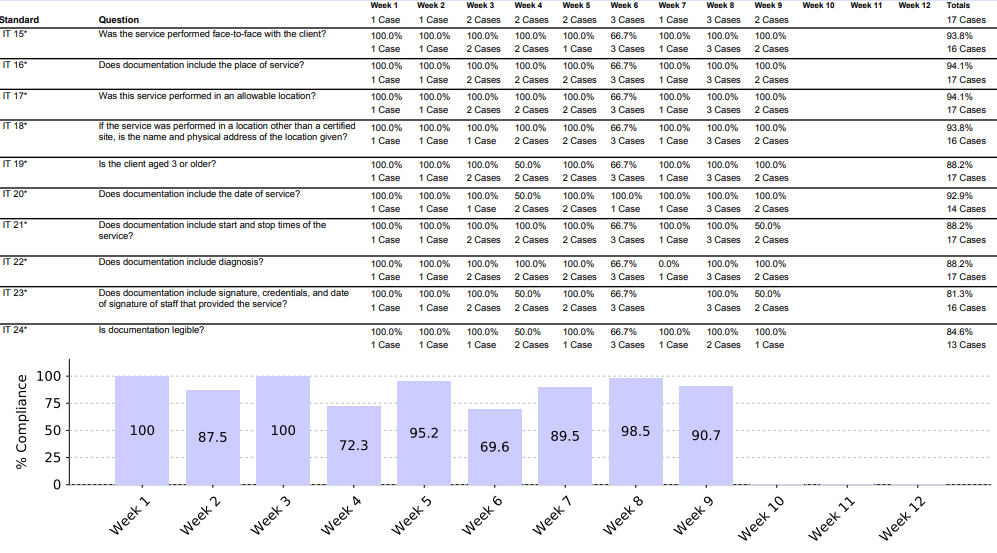
And this is what comes out of it.
One report type is the Question Set Detail report: every question, every week, with the compliance rate underneath.
Actual MOST Interactive report output, from a demonstration organization.
Per question
Which requirement is failing, not just that the program scored well overall.
Per period
Week by week, with the case count behind every percentage.
Per standard
Totals by standard, so the report maps onto the survey you are preparing for.
And it is one report of several. Others detail a single audit, roll many audits together, total the answers across a question set, summarize risk against the compliance rate you set, and list audit activity across the year. Any question set can also be printed as a blank form to work from on paper.
Patterns
See patterns a single audit can't show you.
One audit tells you about one audit. The reports are where a year of them starts to mean something.
Twelve months on one page
A report showing monthly compliance rates across a year, so a trend is visible as a trend: improving, slipping, or flat since the last time anyone looked.
Group by provider, or by anything you record
Filter and group reports by provider, or by any category your agency puts in its audit headers: program, location, service, funder. This is how you see whether one clinician is consistently out of compliance rather than occasionally. That is a supervision conversation, held with evidence instead of impressions.
Dollars at risk
Where question sets carry the amount charged, set a target compliance rate, say 90%, and a report flags services falling below it as at risk for recoupment. Compliance stops being a percentage and becomes a number your finance director can act on.
These figures depend on auditors entering charge amounts faithfully. MOST reports what has been recorded in it; it does not verify billing.
Ready to find out where you stand?
We will show you the software, with your standards in it, and you can decide.